 |
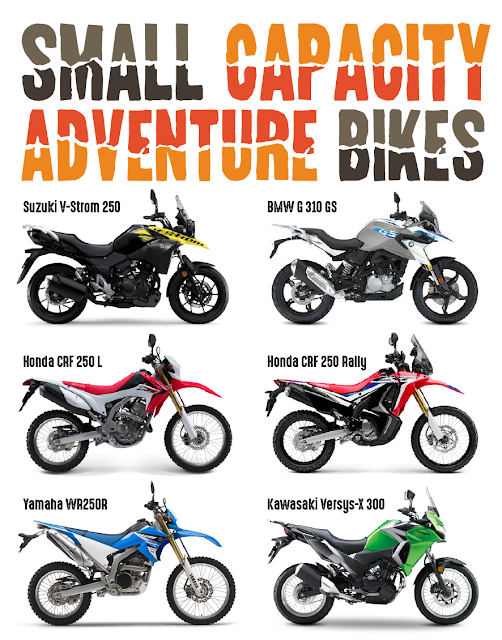
| Small capacity adventure motorcycles for 2017 - Honda CRF 250L, Honda CRF250 Rally, BMW G 310 GS, Kawasaki Versys-X 300, Yamaha WR250R, Suzuki V-Strom 250 |
For some reason several manufacturers have suddenly all
come up with new small capacity offerings for 2017. The "entry level"
bikes show a lot of promise and are a much cheaper alternative to the
traditional GS type bikes. While the small bikes can't compete when it comes to
on road performance, there is much promise and I myself like this new trend a
lot. (I came to the conclusion earlier that a 250 would be nearly ideal to me).
The only niggle with these new offerings is that many if not all of them are more
or less compromises when it comes to suspension for example. The bikes look the
part, but may not deliver the kind of ruggedness or capability as one would
perhaps expect.
The age old moan still stands though as many people are
still wishing and hoping that the big companies would come out with similar
bikes in the 450-500 range. Honda almost did with CB500X, but as it is heavily
road biased it's quite not what the adventure
crowd wants.
I'm very much looking forward to testing all of the new
offerings come spring, but for now I have to stick to evaluate the bikes based
on the specs. Personally I'm so close to getting a 250 I can taste it.
The more I think about the more sense it makes to me. Why? Because of couple of factors.
 |
| Adventure bike spec comparison chart (click to enlarge) |
Things that I'm looking for in these bikes / my next bike
1. I want my bike to relatively new and cheap
(preferably under warranty, which makes Hondas particularly attractive as they
have the longest warranty*)
2. I want lightness. My skillset as a rider needs
all the help I can get.
3. I want to be able to drop the bike with the
financial consequences being manageable. In other words, I don't want the
possible cost of spills to limit my riding or constantly be in the back of my
head.
4. I like simple, much more than I like horsepower, bells
& whistles or status value.
*may not apply to other counties
Whats specs are important (to me)?
1 ergos (stand up postion, knee angle and so on)
2 weight
3 price
4 suspension
5 power to weight ratio
6 range
Thats my list, your order of importance may be different.
ERGOS
By the numbers available (Kawi and Suzuki aren't yet on
cycle-ergo) would want to go with the WR with the second option being the 250
Rally. While the L and the Rally are very similar the ergos are in favor of
the Rally for stand up riding. Looking at the Kawasaki and Suzuki, it is very
unlikely that their ergos will be equal to the WR or Rally. Their seats are
lower and the geometry would suggest a more "crouched" riding
position with more knee bend and riding standing up is likely to be less comfortable.
WEIGHT
Yamaha is +30 kilos lighter than the three fatties, Suzuki, BMW and Kawasaki. The Honda
is still acceptable even in the fatter Rally trim, but the Suzuki and Kawi
certainly are not.
PRICE
Here the WR takes a beating. It's just way too pricey. When
you are asking more than BMW is, you know you have overdone it. The Honda is a
downright bargain given the known quality and long warranty. As an added bonus,
there seems to be a good selection of low mileage bikes available even here in
the edges of civilization. Suzuki and Kawasaki are priced identically, but
Kawasaki literally gives you more bang for the buck.
SUSPENSION
WR gives you the most suspension travel and assumably the
best quality suspension too. (Adjustability and all). The internet wise men say
that Honda has improved from previous years, but that remains to be seen. As
far as Honda's suspension travel, there is conflicting info floating on the
net. Kawasakis suspension travel numbers
seem off, but I got them from the official site, so maybe that really is it?
BMW is only slightly better than Kawasaki, but sporting those alloy wheels, so
in my eyes the Bavarian goes to the bottom of the pile with Suzuki. As for tire sizes,
Honda and Yamaha are the only one offering proper 21' fronts. It is telling that
Suzuki is not even giving out the suspension travel information. Suzuki's
suspension is just referred to as "long travel suspension" and
supposedly that should suffice.
POWER & TORQUE
Yamaha and Kawasaki are topping the power /weight ratio
chart, but given the fact that the Versys is a bit of a fattie for the class,
Yamaha takes the cake. BMW produces good power and torque numbers, but suffers
from it's heavy weight.
BMW bashing aside, Hondas are yet again at the bottom
when it comes to producing power or torque. Sort of a similar case with the AT,
but that's not necessarily a disaster in itself.
The worst of the bunch is Suzuki though. It doesn't have
the weakest engine, but given it's horrible weight, it's power to weight ratio
is the clearly at the bottom of the pack.
RANGE
This is sort of insignificant as any issues can easily be
solved with fuel bladders, Rotopax containers etc. The theory is though that
longer range is better, so in case of a tie, range could be a factor.
Consumption numbers aren't available for all bikes so I had to make assumptions.
Given the similar weight, power and engine size, differences in fuel
consumption should be minimal. Kawasaki blows the competition away in this
category. The 17 litre tank gives the Versys over double the range of Honda and
Yamaha.
CONCLUSION
The sudden onslaught of mini adventure bikes makes it
seem that all the big OEMs suddenly heard the moaning and murmur from the
adventure crowd for a lighter, cheaper less complicated machines. As usual the
message seems to have been somewhat lost in translation as many of the
offerings are just miniaturized versions of their bigger brothers. This again
translates to not added agility, lightness and simplicity, but obese, sluggish
look-alike bikes Suzuki being the worst example. Yamaha who has not jumped on
this band wagon, ironically has the strongest bike offering in this category.
Below is my biased, unprofessional and unscientific scoring chart which will stand until I get to ride them all. (keep in mind that all the data was not available)
 |
| Small capacity adventure bike comparison scoring table (total = average score) |
KTM will most likely offer something a bit more serious, but as the engine size is not known, it's debatable if KTM's offering will even fit in this category.
HONDA - Honda CRF250 Rally
The 250 Rally went from a concept to reality in one year.
While it's essentially a CRF250L with minor mods, it looks good and the mods
make sense. For some reason the Rally makes more power than the 250L for 2017.
Why on earth can't the performance specs be equal of the two bikes is a mystery
to me.
Update Feb 10th
Saw the bike in the flesh at the local dealer. Looked a bit plasticky, but otherwise nice. Pics below.
+ best looking of the bunch
+ reasonably priced
- still a bit low on power
- suspension?
Honda CRF250L
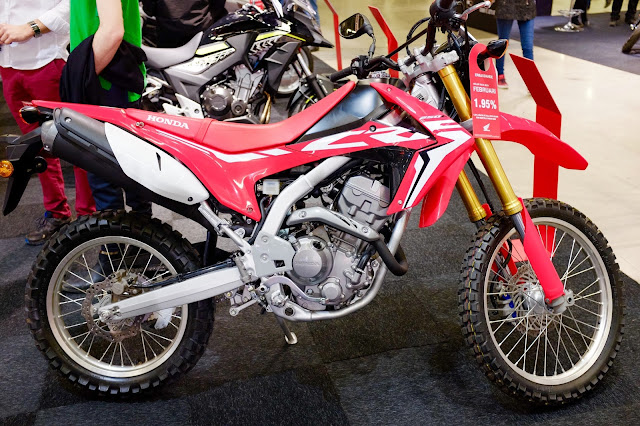 |
| 2017 Honda CRF250L |
It's been around for a while now and has had only minor
improvements for 2017. Suspension isn't exactly stellar, but given the enormous
amount of bang for buck it's understandable.
+ good value
+ proven reliability + good warranty
- suspension
SUZUKI - Suzuki V-Strom 250
The V-Strom looks like the least appealing bike from my perspective. It's the heaviest and has the least potential to be an "offroader" Looking at the specs alone is not really fair, but I can't find anything that would justify choosing it over the others.The Suzukis twin is significantly weaker than Kawasakis power plant.
Upgrading the DR-Z400 and making it EU compliant would have made a far better bike.
+ ?
- heavy
- poor power/weight ratio
- too much fairings
- wheels
KAWASAKI - Kawasaki Versys 300X
The 300x is one of the two twin powered bikes in the group, but
the overly clothed appearance and the twin engine make the heavy. It does produce the most hps, but given the 170kg weight the balance is a bit off
in my opinion. The bike is certainly affordable, but someone looking for a
light, small capacity adventure machine may find the weight hard to justify. I
find the Kawasaki styling a bit late 90s, but that's just me and makes no
difference if the machine performs well.
Photos below are from the Stockholm Motorcycle Show
Kawasaki has also stopped importing the KLX250S (at least
in some EU countries) , so the 250S is no longer an option for those looking
for a brand new bike.
+ the only twin in the group
+ big tank
- too much fairings
- heavy
BMW - BMW GS
The GS is riding heavily on the fame of the older
brothers, but doesn't really seem to be designed for the same task. Styling
wise the bike seems a bit overdone. It looks like they tried to force the GS
clothes on it and they don't quite fit. The BMW is the only bike in the group
with alloy wheels. Pricing should be competitive with the others, but that's
just a guess based on how the bike is priced overseas. The 310 is the torque
king of the group.
+ most torque
- alloy wheels
- styling
YAMAHA - Yamaha WR250R
Yamaha has sort of missed the boat and has not brought
anything new to compete with the new offerings. That said the WR is probably
still the best bike of the bunch. Class leading power to weight ratio and best
suspension of the lot. Another big thing is the weight. The WR weighs only 134
kgs wet, which is much more in the neighborhood what these 250 should weigh. If
you look purely at the specs, it's a bit of a mystery where all the development
of the other bikes has gone as they are all slower and heavier by comparison.
+ weight
+ suspension
- price
KTM - KTM 390 Adventure
The 390 adventure is a bit of a mystery still. It's
coming out in 2018 and it may be bigger than 390. If that's true, KTM may have
real winner in it's hands.
I'm also wondering what happened to the spied 390
supermoto? It seems that it was quietly dropped.
[UPDATE March 2017]
The 690 is gone and a brand new Honda CRF 250 Rally is waiting for me at the bike shop.
The story continues here
https://honda250rally.com/


